

Night Train

After it’s long overnight journey from Osaka, the Twilight Express nears Sapporo, its final destination
Despite Japan’s expansive network of Bullet trains, and some of the world’s busiest domestic air routes, a few sleeper trains still survive, carrying passengers directly from the heart of the great metropolises to small destinations at the far reaches of the country. Despite a reputation to the contrary, Japan is actually a medium sized country, and more to the point it is long and thin, and spread over several islands, so domestic journeys are often much longer than we’re used to in the UK. Imagine getting on a train amidst the hustle and bustle of Tokyo or Osaka, and then spending a leisurely day watching a whole country speeding past outside. Mountain ranges roamed by bears and wild boar are interspersed with tiny villages surrounded by rice paddies, giant forests, and big industrial cities. You can retire to bed as the sun sets over the sea, and wake up the next morning in the snowy wilds of Hokkaido, or crossing the Great Seto Bridge to the island of Shikoku.
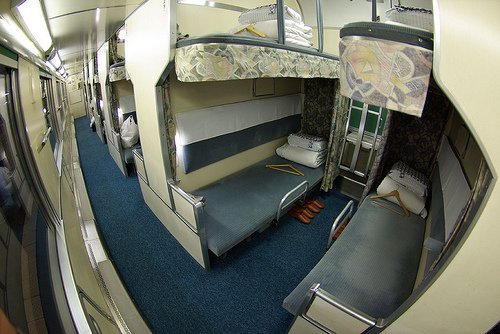
Bunk-accommodation on the Nihonkai train, which runs from Osaka to Aomori
Accommodation on the trains caters to a huge span of prices, and corresponding levels of comfort. Many night trains have seats, but a much more attractive budget option is the traditional Japanese option of sleeping on the floor. A narrow walkway runs along one side of these carriages, where you leave your shoes before stepping up onto the carpeted sleeping area. Pillows and blankets are provided, so you can stretch out across the width of the train and get a good night’s sleep. This arrangement is so much more comfortable than a seat that I sometimes wish that airlines would adopt the same arrangement for long-haul flights. For the less adventurous, or those with bigger wallets, there are also shared cabins with bunk beds, and private single or twin rooms. Some rooms are as luxurious as a hotel room, providing all the usual freebies and facilities, even to the point of having ensuite showers.

The sunrise express, which connects Tokyo with cities in the west of Japan and on the island of Shikoku, pictured here on the outskirts of greater Tokyo
The popularity of sleeper trains peeked in the late 70s, but nowadays they are undergoing something of a renaissance, having reinvented themselves as ‘cruises on wheels’, rather than simply practical ways to cover large distances. Lounge cars with big viewing windows provide an opportunity to mix with fellow travellers, who are usually friendly and keen to chat – foreigners providing the added attraction of the chance to try out seldom used English skills. Eating options range from popping off at one of the stops to buy a boxed lunch from a platform shop, to deluxe French dinners in the restaurant car. Food prices on board tend to be very reasonable – roughly in line with what you would pay for the same kind of meal in a stationary eatery.

This is a suite on the Twilight Express. Imagine being able to lie in bed and watch the scenery disappear into the distance behind you.
The most popular night train in Japan is the Cassiopeia, which is also the most luxurious – all accommodation being in private rooms. It leaves Tokyo every second day in the late afternoon, and travels up the pacific coast, through the world’s longest undersea tunnel to Hokkaido, finally arriving in the far northern city of Sapporo at about nine-thirty the next morning. While not quite as luxurious, the Twilight Express from Osaka is the king of night trains. It begins its journey just before noon, passing through Kyoto, then around the shore of Lake Biwa, Japan’s biggest lake, and up the sparsely populated Sea of Japan coast, before it also passes through the tunnel to Hokkaido, arriving in Sapporo shortly after the Cassiopeia. The epic journey takes around 22 hours and covers 929 miles – making it by far the longest train route in Japan. The biggest draw on both these trains are the private suites at the back. You can lie in bed facing the big picture window that spans the rear of the train, watching the scenery fade away behind as you journey north. You need to book early to obtain these premium suites, but even if you can’t get one, the Cassiopeia offers a consolation – a lounge car at the other end of the train which, on the return journey, makes a similar view available to everyone.

If you travel on the Cassiopeia, be sure to take advantage of this lounge car, where you can mingle with other passengers, or just sit back and admire the view
If boats are more your thing than trains, a parallel experience is available on overnight ferries to the islands south of Tokyo, or to tropical Okinawa in Japan’s far south-west, as well as on host of coastal ferries connecting Japan’s four main islands. Most routes offer a similar range of accommodation options to night trains, and the chance to reach parts of Japan rarely experienced by foreign visitors. Whether you choose to make the journey in luxury or sleeping on the floor, travelling overnight by train or boat can be an unforgettable experience, and not only do you avoid wasting a day of your holiday travelling, you also save on cost of one night’s hotel accommodation. Train bookings can be made at JR ticket offices nationwide. Cassiopeia has a special webpage in English, but for the Twilight Express details are only available in Japanese.
Update
Unfortunately progress has now done for almost all of Japan’s sleeper trains. The only survivors are the Sunrise Izumo and Sunrise Seto that connect Tokyo with Izumo in Western Japan and with Takamatsu on the island of Shikoku. The two trains run together between Tokyo and Okayama City, where they split up to each go their separate ways.
Even the mighty Cassiopeia and Twilight Express have called it quits, although the Twilight Express is spending its retirement as an exhibit at Kyoto Railway Museum.
There is some good news though, and it goes by the name of ‘cruise trains’. These super-luxurious vehicles don’t pretend to transport anyone to or from anywhere – but instead make round trips – usually lasting between two and four days. The first of these is the Kyushu Railway Company’s Seven Stars in Kyushu which debuted in 2013. All journeys begin and end at Hakata station in Fukuoka. The longer trips head down the east coast of Kyushu, passing through Miyazaki and Kagoshima, and return via Aso volcano and the hot-spring resort Yufuin. The two-day cruises first head to Nagasaki, and then also return to Fukuoka via Aso and Yufuin. Each cabin has an en-suite shower and toilet, and even the smallest is ten square metres – as big as a small apartment in Tokyo. There is an observation room at the front of the train, a bar and a dining car. Tickets prices range from ¥250,000 to ¥1,400,000.
The replacements for the Twilight Express and the Cassiopeia will be the Twilight Express Mizukaze and the Shiki-Shima, both scheduled to begin operation in 2017. Each will have 6 sleeping cars, a lounge car, a dining car and an observation car at each end. One of the sleeping cars on the Shiki-Shima will have only two rooms, one of which will be a two-floor maisonette. The Twilight Express Mizukaze will have an even more opulent room, taking up the whole of one carriage and with its own private balcony. These luxury rooms come with their own baths, but other cruisers will have to make do with en-suite showers.
So, if you want to experience a sleeper train in Japan, either do it quickly before the Sunrise Seto and Sunrise Izumo are phased out, or get saving because you’ll need a small fortune to ride a cruise train.
Minshuku